


Abstract
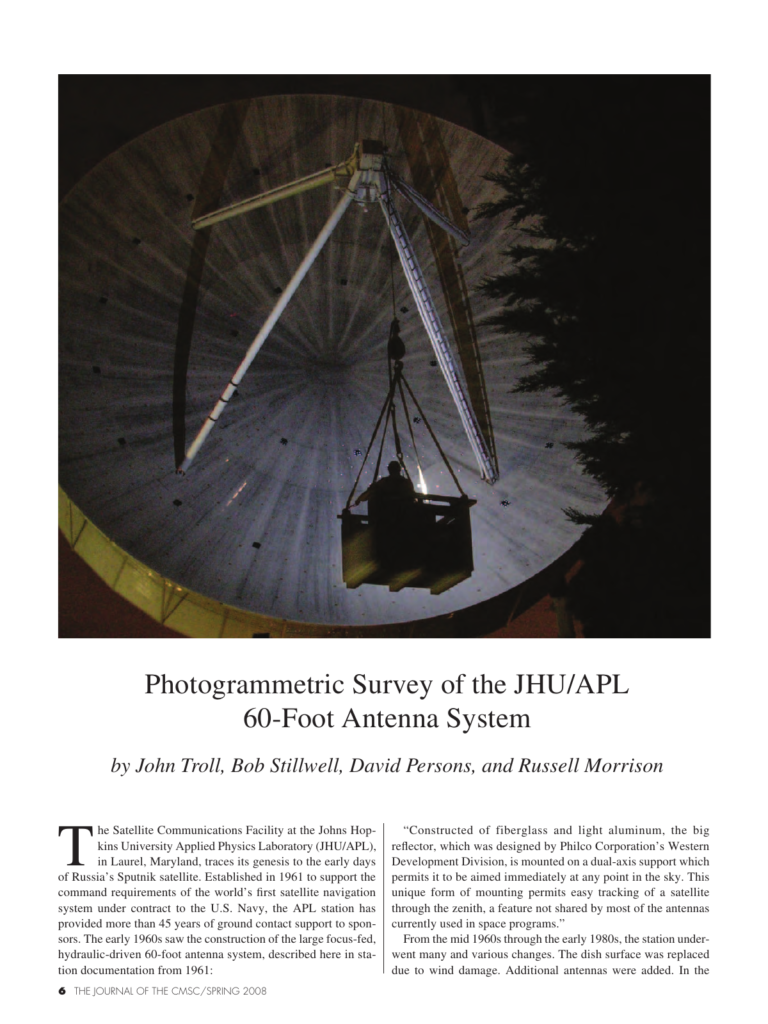
The Satellite Communications Facility at the Johns Hopkins University Applied Physics Laboratory (JHU/APL), in Laurel, Maryland, traces its genesis to the early days of Russia’s Sputnik satellite. Established in 1961 to support the command requirements of the world’s first satellite navigation system under contract to the U.S. Navy, the APL station has provided more than 45 years of ground contact support to sponsors. The early 1960s saw the construction of the large focus-fed, hydraulic-driven 60-foot antenna system, described here in station documentation from 1961: 6 The Journal of the CMSC/SPRING 2008 “Constructed of fiberglass and light aluminum, the big reflector, which was designed by Philco Corporation’s Western Development Division, is mounted on a dual-axis support which permits it to be aimed immediately at any point in the sky. This unique form of mounting permits easy tracking of a satellite through the zenith, a feature not shared by most of the antennas currently used in space programs.” From the mid 1960s through the early 1980s, the station underwent many and various changes. The dish surface was replaced due to wind damage. Additional antennas were added. In the
Also published as CMS-2007-014, CMSC 2007, Reno, NV.
Cite this article
John Troll, Bob Stillwell, David Persons, Russell Morrison. The Journal of the CMSC, Volume 3, Number 1, Spring 2008. Coordinate Metrology Society, reference CMSJ-03-1-01.