


Abstract
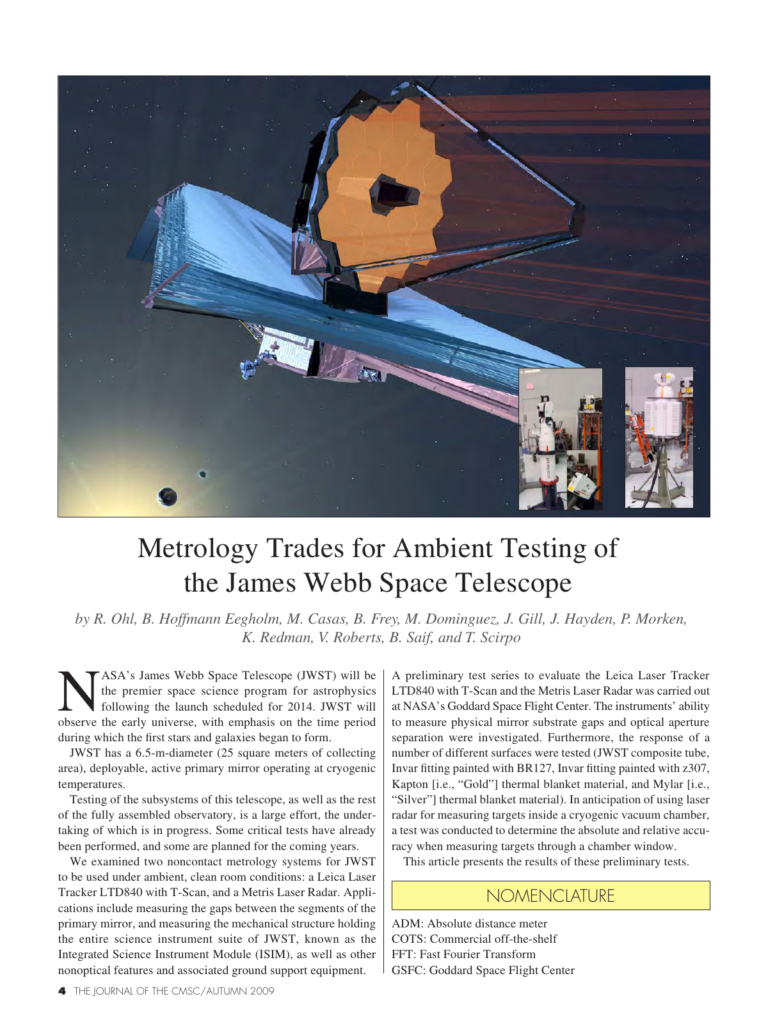
ASA’s James Webb Space Telescope (JWST) will be the premier space science program for astrophysics following the launch scheduled for 2014. JWST will observe the early universe, with emphasis on the time period during which the first stars and galaxies began to form. JWST has a 6.5-m-diameter (25 square meters of collecting area), deployable, active primary mirror operating at cryogenic temperatures. Testing of the subsystems of this telescope, as well as the rest of the fully assembled observatory, is a large effort, the undertaking of which is in progress. Some critical tests have already been performed, and some are planned for the coming years. We examined two noncontact metrology systems for JWST to be used under ambient, clean room conditions: a Leica Laser Tracker LTD840 with T-Scan, and a Metris Laser Radar. Applications include measuring the gaps between the segments of the primary mirror, and measuring the mechanical structure holding the entire science instrument suite of JWST, known as the Integrated Science Instrument Module (ISIM), as well as other nonoptical features and associated ground support equipment. A preliminary test series to evaluate the Leica Laser Tracker LTD840 with T-Scan and the Metris Laser Radar was carried out at NASA’s Goddard Space Flight Center. The instruments’ ability to measure physical mirror substrate gaps and optical aperture separation were investigated. Furthermore, the response of a number of different surfaces were tested (JWST c
Also published as CMS-2009-004, CMSC 2009, Louisville, KY.
Cite this article
R. Ohl, B. Hoffmann Eegholm, M. Casas, B. Frey, M. Dominguez, J. Gill, J. Hayden, P. Morken, K. Redman, V. Roberts, B. Saif, T. Scirpo. The Journal of the CMSC, Volume 4, Number 2, Autumn 2009. Coordinate Metrology Society, reference CMSJ-04-2-01.