


Abstract
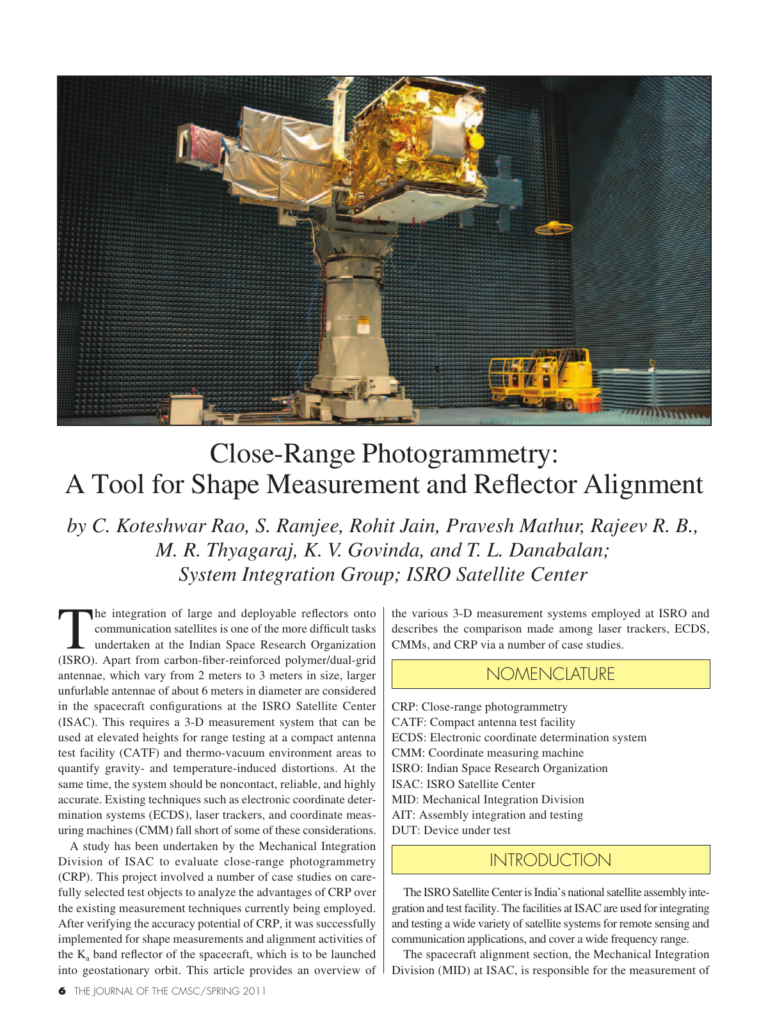
The integration of large and deployable reflectors onto communication satellites is one of the more difficult tasks undertaken at the Indian Space Research Organization (ISRO). Apart from carbon-fiber-reinforced polymer/dual-grid antennae, which vary from 2 meters to 3 meters in size, larger unfurlable antennae of about 6 meters in diameter are considered in the spacecraft configurations at the ISRO Satellite Center (ISAC). This requires a 3-D measurement system that can be used at elevated heights for range testing at a compact antenna test facility (CATF) and thermo-vacuum environment areas to quantify gravity- and temperature-induced distortions. At the same time, the system should be noncontact, reliable, and highly accurate. Existing techniques such as electronic coordinate determination systems (ECDS), laser trackers, and coordinate measuring machines (CMM) fall short of some of these considerations. A study has been undertaken by the Mechanical Integration Division of ISAC to evaluate close-range photogrammetry (CRP). This project involved a number of case studies on carefully selected test objects to analyze the advantages of CRP over the existing measurement techniques currently being employed. After verifying the accuracy potential of CRP, it was successfully implemented for shape measurements and alignment activities of the Ka band reflector of the spacecraft, which is to be launched into geostationary orbit. This article provides an overview of 6 The Journal of the
Also published as CMS-2010-007, CMSC 2010, Reno, NV.
Cite this article
C. Koteshwar Rao, S. Ramjee, Rohit Jain, Pravesh Mathur, Rajeev R. B., M. R. Thyagaraj, K. V. Govinda, T. L. Danabalan. System Integration Group, ISRO Satellite Center. The Journal of the CMSC, Volume 6, Number 1, Spring 2011. Coordinate Metrology Society, reference CMSJ-06-1-01.