


Abstract
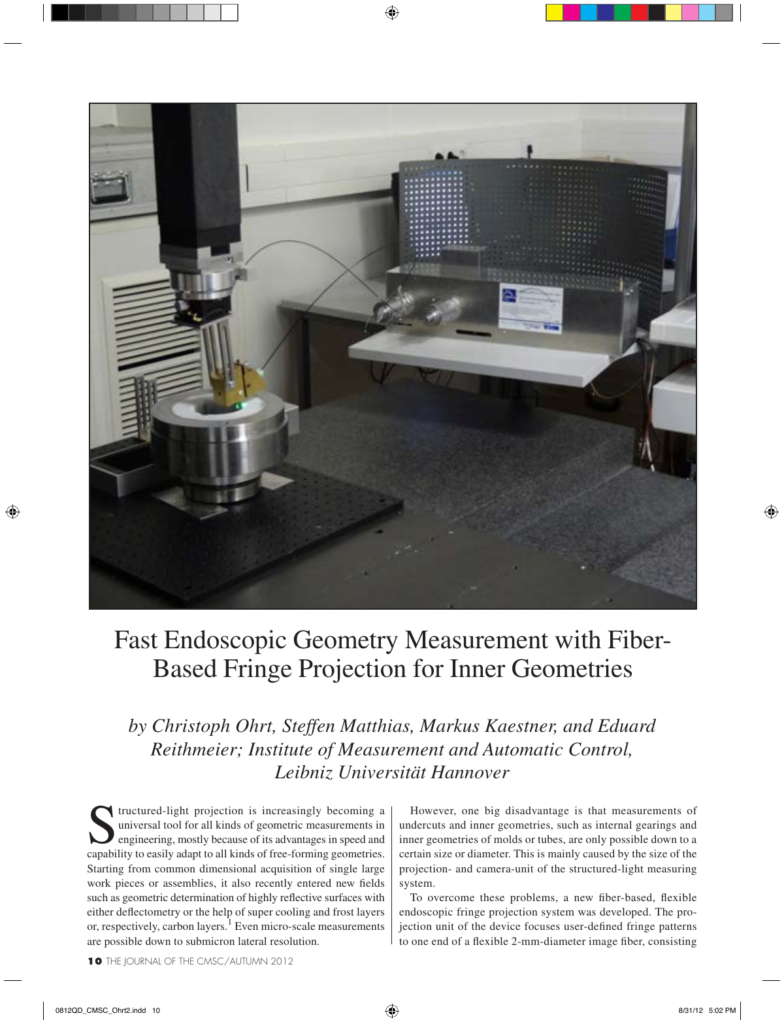
Structured-light projection is increasingly becoming a universal tool for all kinds of geometric measurements in engineering, mostly because of its advantages in speed and capability to easily adapt to all kinds of free-forming geometries. Starting from common dimensional acquisition of single large work pieces or assemblies, it also recently entered new fields such as geometric determination of highly reflective surfaces with either deflectometry or the help of super cooling and frost layers or, respectively, carbon layers.1 Even micro-scale measurements are possible down to submicron lateral resolution. However, one big disadvantage is that measurements of undercuts and inner geometries, such as internal gearings and inner geometries of molds or tubes, are only possible down to a certain size or diameter. This is mainly caused by the size of the projection- and camera-unit of the structured-light measuring system. To overcome these problems, a new fiber-based, flexible endoscopic fringe projection system was developed. The projection unit of the device focuses user-defined fringe patterns to one end of a flexible 2-mm-diameter image fiber, consisting
Cite this article
Christoph Ohrt, Steffen Matthias, Markus Kaestner, Eduard Reithmeier. Institute of Measurement and Automatic Control, Leibniz Universität Hannover. The Journal of the CMSC, Volume 7, Number 2, Autumn 2012. Coordinate Metrology Society, reference CMSJ-07-2-02.