


Abstract
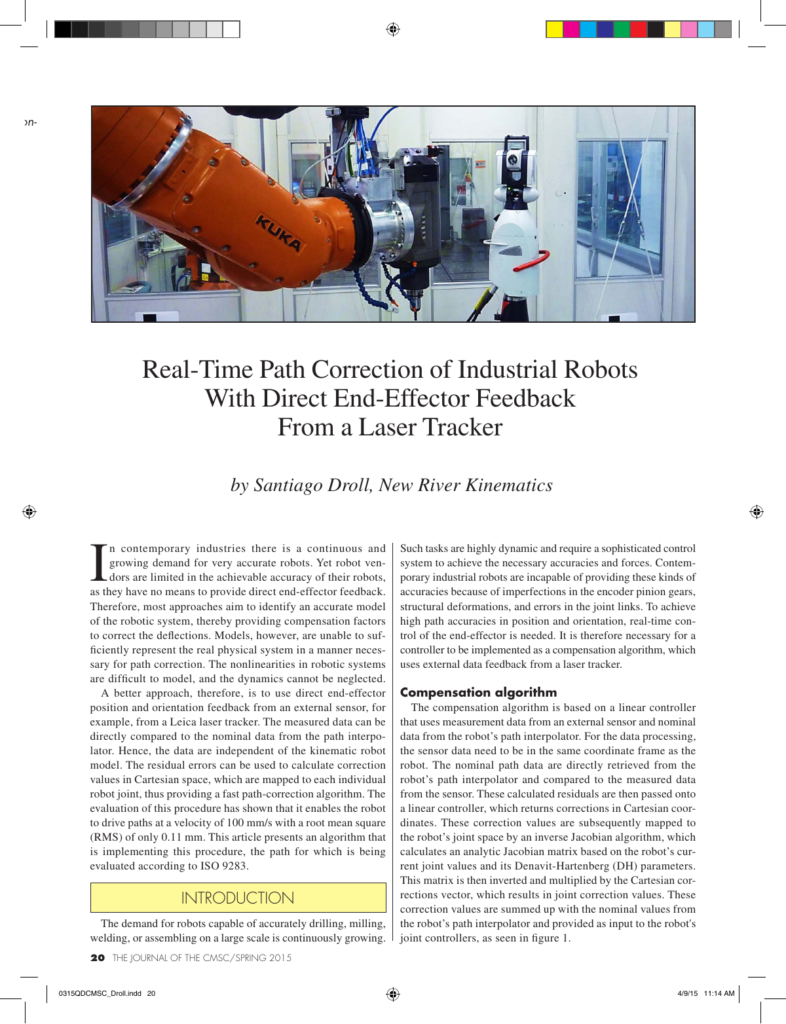
In contemporary industries there is a continuous and growing demand for very accurate robots. Yet robot vendors are limited in the achievable accuracy of their robots, as they have no means to provide direct end-effector feedback. Therefore, most approaches aim to identify an accurate model of the robotic system, thereby providing compensation factors to correct the deflections. Models, however, are unable to sufficiently represent the real physical system in a manner necessary for path correction. The nonlinearities in robotic systems are difficult to model, and the dynamics cannot be neglected. A better approach, therefore, is to use direct end-effector position and orientation feedback from an external sensor, for example, from a Leica laser tracker. The measured data can be directly compared to the nominal data from the path interpolator. Hence, the data are independent of the kinematic robot model. The residual errors can be used to calculate correction values in Cartesian space, which are mapped to each individual robot joint, thus providing a fast path-correction algorithm. The evaluation of this procedure has shown that it enables the robot to drive paths at a velocity of 100 mm/s with a root mean square (RMS) of only 0.11 mm. This article presents an algorithm that is implementing this procedure, the path for which is being evaluated according to ISO 9283. Such tasks are highly dynamic and require a sophisticated control system to achieve the necessary accuracies and
Cite this article
Santiago Droll. New River Kinematics. The Journal of the CMSC, Volume 10, Number 1, Spring 2015. Coordinate Metrology Society, reference CMSJ-10-1-03.