


Abstract
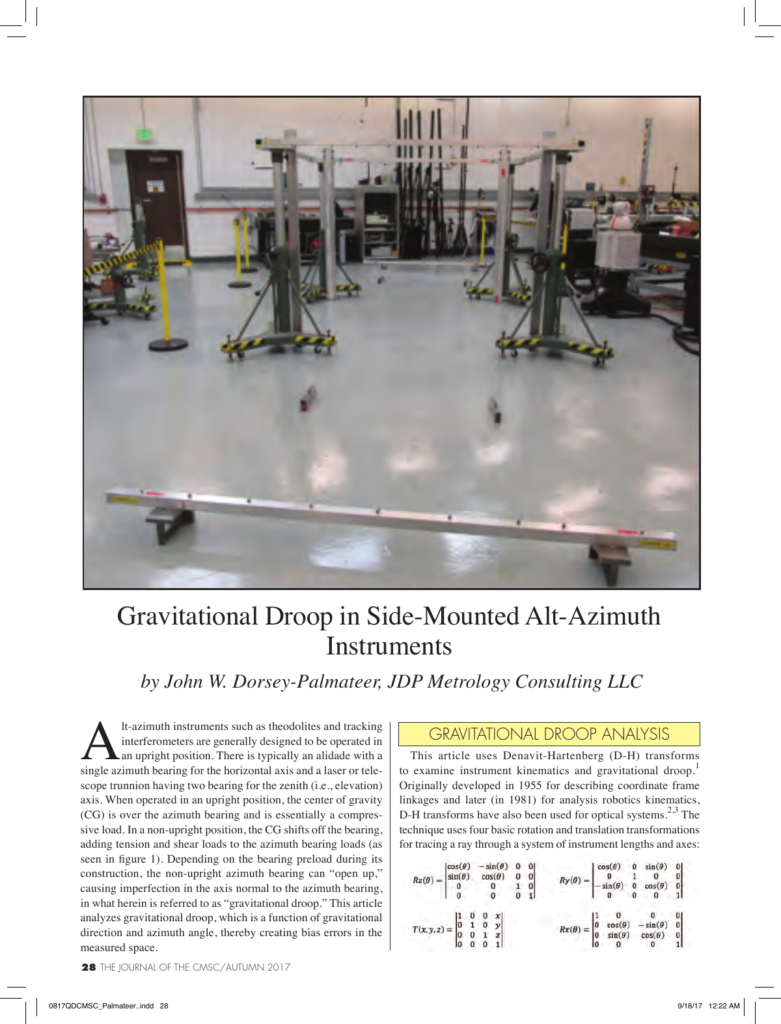
Alt-azimuth instruments such as theodolites and tracking interferometers are generally designed to be operated in an upright position. There is typically an alidade with a single azimuth bearing for the horizontal axis and a laser or telescope trunnion having two bearing for the zenith (i.e., elevation) axis. When operated in an upright position, the center of gravity (CG) is over the azimuth bearing and is essentially a compressive load. In a non-upright position, the CG shifts off the bearing, adding tension and shear loads to the azimuth bearing loads (as seen in figure 1). Depending on the bearing preload during its construction, the non-upright azimuth bearing can “open up,” causing imperfection in the axis normal to the azimuth bearing, in what herein is referred to as “gravitational droop.” This article analyzes gravitational droop, which is a function of gravitational direction and azimuth angle, thereby creating bias errors in the measured space. GRAVITATIONAL DROOP ANALYSIS This article uses Denavit-Hartenberg (D-H) transforms to examine instrument kinematics and gravitational droop. 1 Originally developed in 1955 for describing coordinate frame linkages and later (in 1981) for analysis robotics kinematics, D-H transforms have also been used for optical systems.2,3 The technique uses four basic rotation and translation transformations for tracing a ray through a system of instrument lengths and axes:
Also published as CMS-2017-015, CMSC 2017, Snowbird, UT.
Cite this article
John W. Dorsey-Palmateer. JDP Metrology Consulting LLC. The Journal of the CMSC, Volume 12, Number 2, Autumn 2017. Coordinate Metrology Society, reference CMSJ-12-2-04.