


Abstract
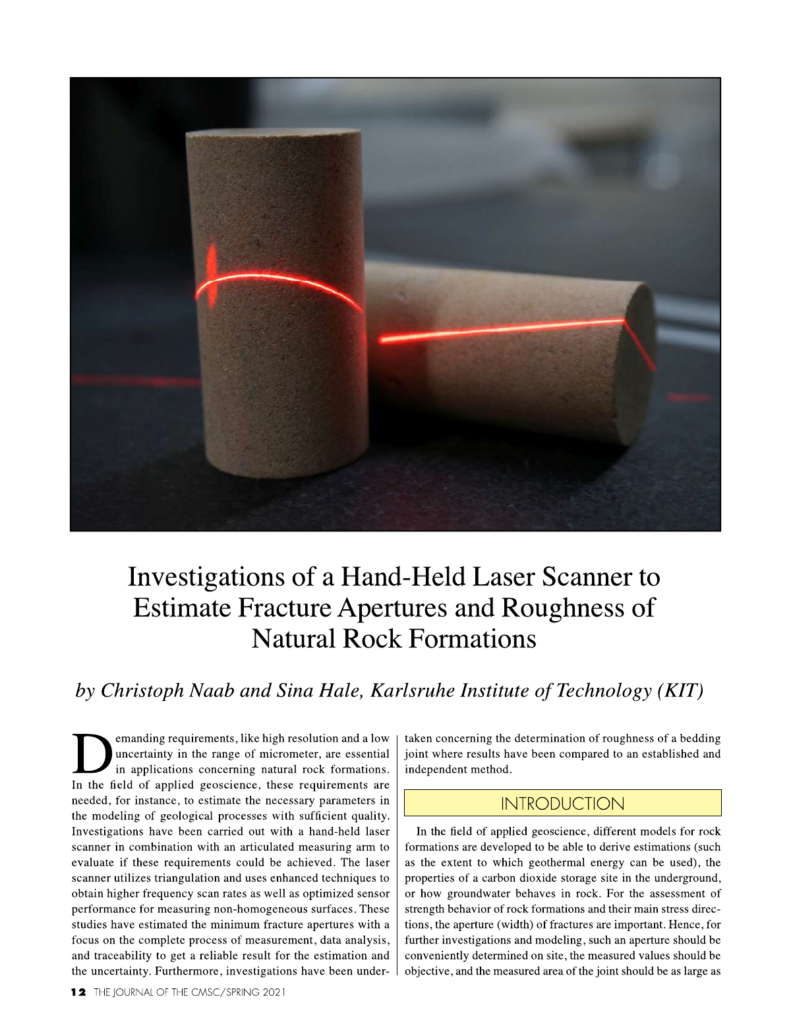
Demanding requirements, like high resolution and a low uncertainty in the range of micrometer, are essential in applications concerning natural rock formations. In the field of applied geoscience, these requirements are needed, for instance, to estimate the necessary parameters in the modeling of geological processes with sufficient quality. Investigations have been carried out with a hand-held laser scanner in combination with an articulated measuring arm to evaluate if these requirements could be achieved. The laser scanner utilizes triangulation and uses enhanced techniques to obtain higher frequency scan rates as well as optimized sensor performance for measuring non-homogeneous surfaces. These studies have estimated the minimum fracture apertures with a focus on the complete process of measurement, data analysis, and traceability to get a reliable result for the estimation and the uncertainty. Furthermore, investigations have been undertaken concerning the determination of roughness of a bedding joint where results have been compared to an established and independent method.
Also published as CMS-2020-009, CMSC 2020, virtual, September.
Cite this article
Christoph Naab, Sina Hale. Karlsruhe Institute of Technology (KIT). The Journal of the CMSC, Volume 16, Number 1, Spring 2021. Coordinate Metrology Society, reference CMSJ-16-1-01.