


Abstract
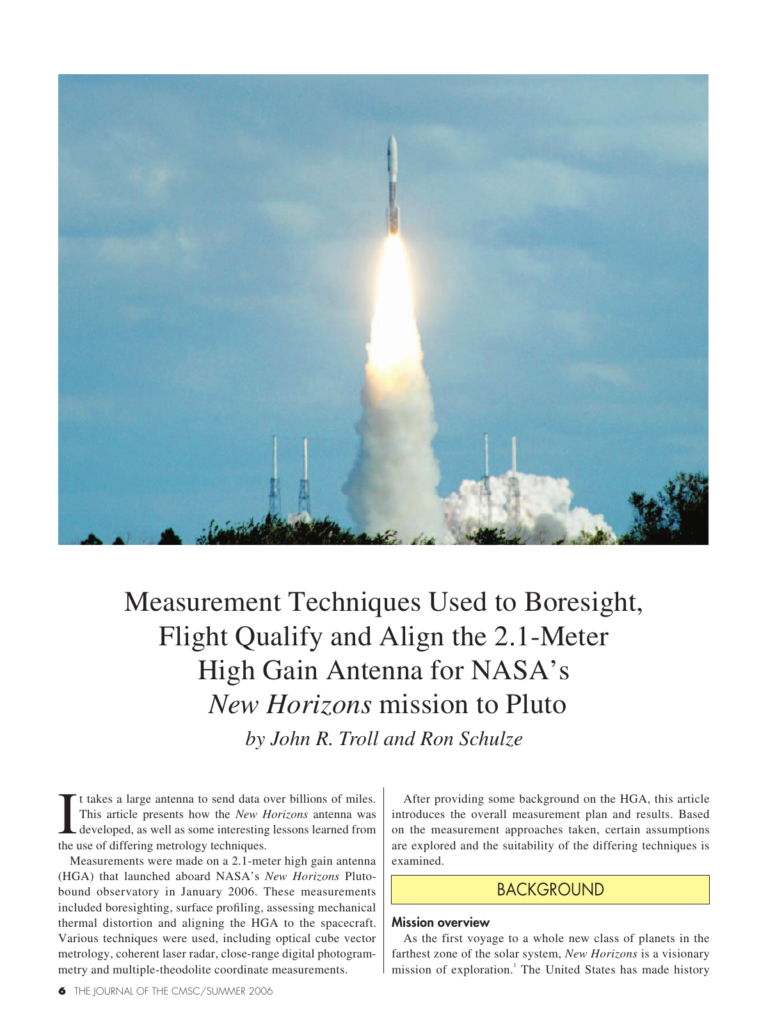
It takes a large antenna to send data over billions of miles. This article presents how the New Horizons antenna was developed, as well as some interesting lessons learned from the use of differing metrology techniques. Measurements were made on a 2.1-meter high gain antenna (HGA) that launched aboard NASA’s New Horizons Plutobound observatory in January 2006. These measurements included boresighting, surface profiling, assessing mechanical thermal distortion and aligning the HGA to the spacecraft. Various techniques were used, including optical cube vector metrology, coherent laser radar, close-range digital photogrammetry and multiple-theodolite coordinate measurements. After providing some background on the HGA, this article introduces the overall measurement plan and results. Based on the measurement approaches taken, certain assumptions are explored and the suitability of the differing techniques is examined.
Also published as CMS-2005-002, CMSC 2005, Austin, TX.
Cite this article
John R. Troll, Ron Schulze. The Journal of the CMSC, Volume 1, Number 1, Summer 2006. Coordinate Metrology Society, reference CMSJ-01-1-01.