


Abstract
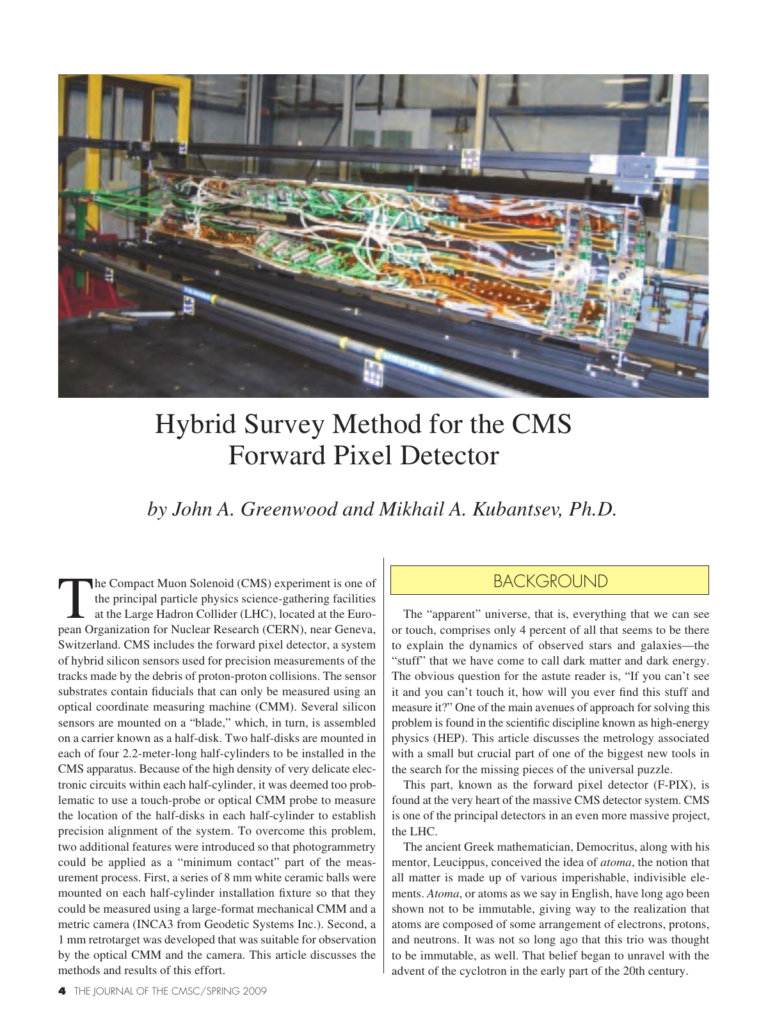
The Compact Muon Solenoid (CMS) experiment is one of the principal particle physics science-gathering facilities at the Large Hadron Collider (LHC), located at the European Organization for Nuclear Research (CERN), near Geneva, Switzerland. CMS includes the forward pixel detector, a system of hybrid silicon sensors used for precision measurements of the tracks made by the debris of proton-proton collisions. The sensor substrates contain fiducials that can only be measured using an optical coordinate measuring machine (CMM). Several silicon sensors are mounted on a “blade,” which, in turn, is assembled on a carrier known as a half-disk. Two half-disks are mounted in each of four 2.2-meter-long half-cylinders to be installed in the CMS apparatus. Because of the high density of very delicate electronic circuits within each half-cylinder, it was deemed too problematic to use a touch-probe or optical CMM probe to measure the location of the half-disks in each half-cylinder to establish precision alignment of the system. To overcome this problem, two additional features were introduced so that photogrammetry could be applied as a “minimum contact” part of the measurement process. First, a series of 8 mm white ceramic balls were mounted on each half-cylinder installation fixture so that they could be measured using a large-format mechanical CMM and a metric camera (INCA3 from Geodetic Systems Inc.). Second, a 1 mm retrotarget was developed that was suitable for observation by the opt
Cite this article
John A. Greenwood, Mikhail A. Kubantsev. The Journal of the CMSC, Volume 4, Number 1, Spring 2009. Coordinate Metrology Society, reference CMSJ-04-1-01.