


Abstract
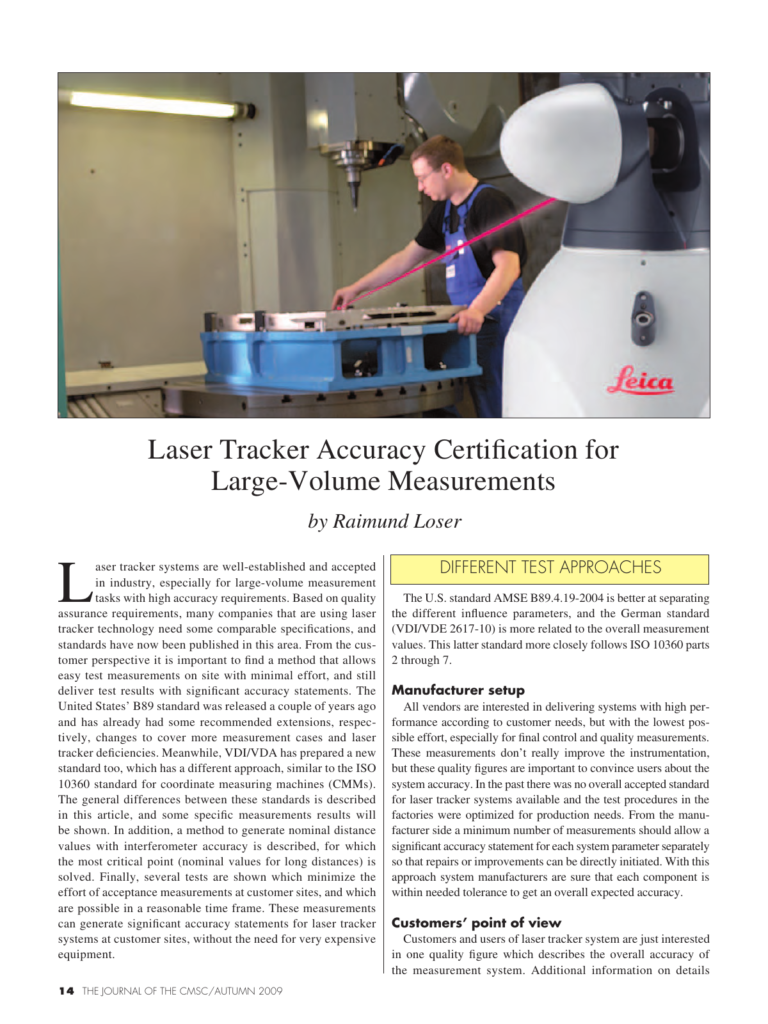
Laser tracker systems are well-established and accepted in industry, especially for large-volume measurement tasks with high accuracy requirements. Based on quality assurance requirements, many companies that are using laser tracker technology need some comparable specifications, and standards have now been published in this area. From the customer perspective it is important to find a method that allows easy test measurements on site with minimal effort, and still deliver test results with significant accuracy statements. The United States’ B89 standard was released a couple of years ago and has already had some recommended extensions, respectively, changes to cover more measurement cases and laser tracker deficiencies. Meanwhile, VDI/VDA has prepared a new standard too, which has a different approach, similar to the ISO 10360 standard for coordinate measuring machines (CMMs). The general differences between these standards is described in this article, and some specific measurements results will be shown. In addition, a method to generate nominal distance values with interferometer accuracy is described, for which the most critical point (nominal values for long distances) is solved. Finally, several tests are shown which minimize the effort of acceptance measurements at customer sites, and which are possible in a reasonable time frame. These measurements can generate significant accuracy statements for laser tracker systems at customer sites, without the need for very expen
Also published as CMS-2009-010, CMSC 2009, Louisville, KY.
Cite this article
Raimund Loser. The Journal of the CMSC, Volume 4, Number 2, Autumn 2009. Coordinate Metrology Society, reference CMSJ-04-2-03.