


Abstract
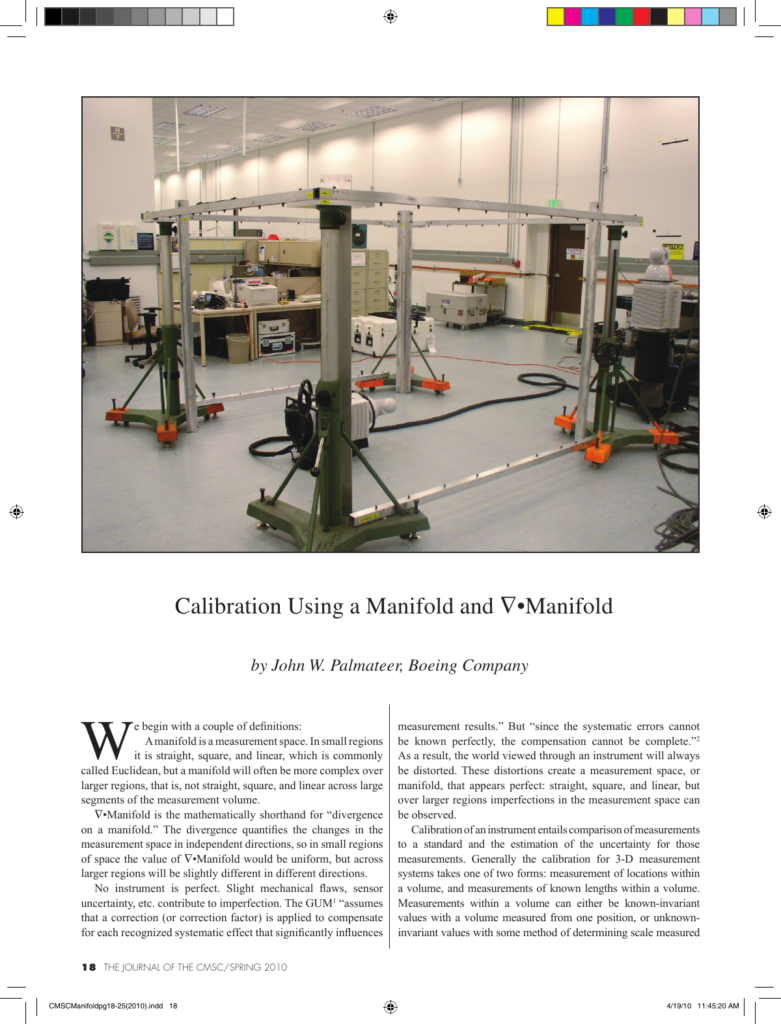
We begin with a couple of definitions: A manifold is a measurement space. In small regions it is straight, square, and linear, which is commonly called Euclidean, but a manifold will often be more complex over larger regions, that is, not straight, square, and linear across large segments of the measurement volume. ∇•Manifold is the mathematically shorthand for “divergence on a manifold.” The divergence quantifies the changes in the measurement space in independent directions, so in small regions of space the value of ∇•Manifold would be uniform, but across larger regions will be slightly different in different directions. No instrument is perfect. Slight mechanical flaws, sensor uncertainty, etc. contribute to imperfection. The GUM1 “assumes that a correction (or correction factor) is applied to compensate for each recognized systematic effect that significantly influences measurement results.” But “since the systematic errors cannot be known perfectly, the compensation cannot be complete.”2 As a result, the world viewed through an instrument will always be distorted. These distortions create a measurement space, or manifold, that appears perfect: straight, square, and linear, but over larger regions imperfections in the measurement space can be observed. Calibration of an instrument entails comparison of measurements to a standard and the estimation of the uncertainty for those measurements. Generally the calibration for 3-D measurement systems takes one of two forms: measur
Also published as CMS-2009-014, CMSC 2009, Louisville, KY.
Cite this article
John W. Palmateer. The Boeing Company. The Journal of the CMSC, Volume 5, Number 1, Spring 2010. Coordinate Metrology Society, reference CMSJ-05-1-03.