


Abstract
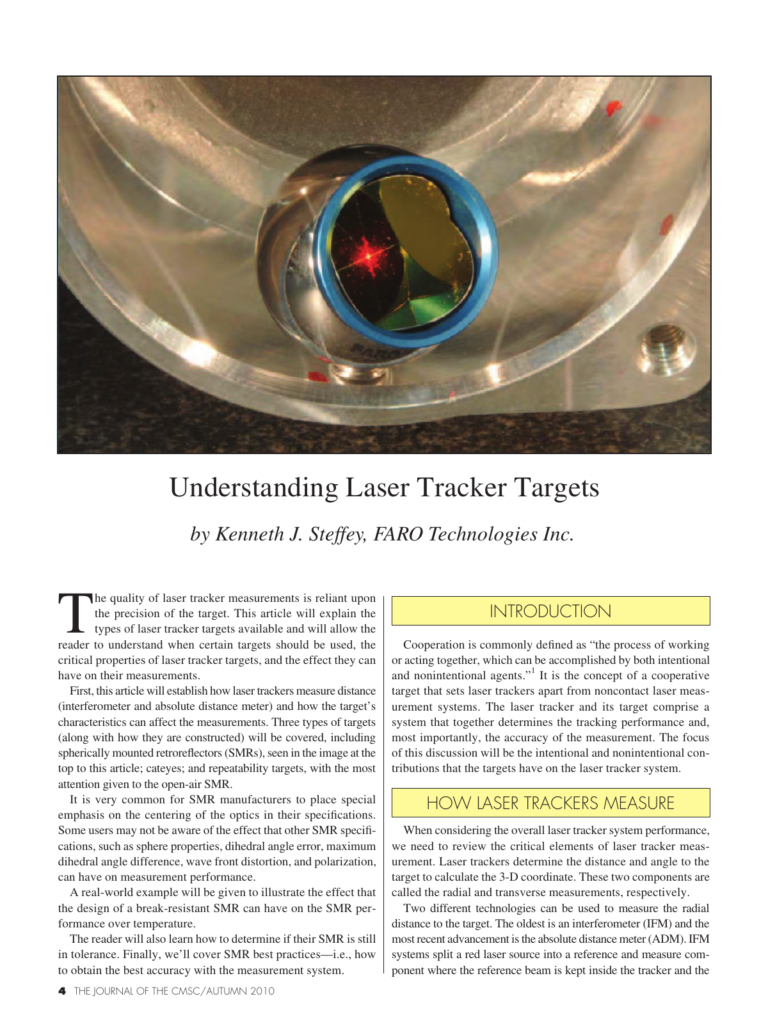
The quality of laser tracker measurements is reliant upon the precision of the target. This article will explain the types of laser tracker targets available and will allow the reader to understand when certain targets should be used, the critical properties of laser tracker targets, and the effect they can have on their measurements. First, this article will establish how laser trackers measure distance (interferometer and absolute distance meter) and how the target’s characteristics can affect the measurements. Three types of targets (along with how they are constructed) will be covered, including spherically mounted retroreflectors (SMRs), seen in the image at the top to this article; cateyes; and repeatability targets, with the most attention given to the open-air SMR. It is very common for SMR manufacturers to place special emphasis on the centering of the optics in their specifications. Some users may not be aware of the effect that other SMR specifications, such as sphere properties, dihedral angle error, maximum dihedral angle difference, wave front distortion, and polarization, can have on measurement performance. A real-world example will be given to illustrate the effect that the design of a break-resistant SMR can have on the SMR performance over temperature. The reader will also learn how to determine if their SMR is still in tolerance. Finally, we’ll cover SMR best practices—i.e., how to obtain the best accuracy with the measurement system. 4 The Journal of the C
Also published as CMS-2010-035, CMSC 2010, Reno, NV.
Cite this article
Kenneth J. Steffey. FARO Technologies Inc. The Journal of the CMSC, Volume 5, Number 2, Autumn 2010. Coordinate Metrology Society, reference CMSJ-05-2-01.