


Abstract
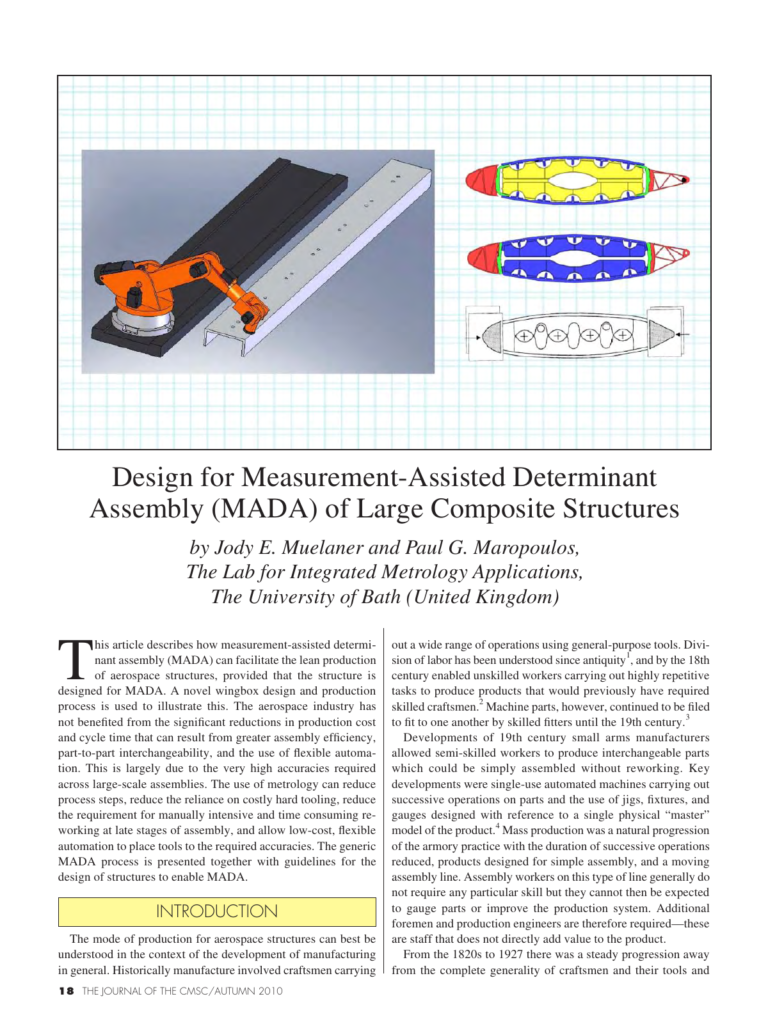
This article describes how measurement-assisted determinant assembly (MADA) can facilitate the lean production of aerospace structures, provided that the structure is designed for MADA. A novel wingbox design and production process is used to illustrate this. The aerospace industry has not benefited from the significant reductions in production cost and cycle time that can result from greater assembly efficiency, part-to-part interchangeability, and the use of flexible automation. This is largely due to the very high accuracies required across large-scale assemblies. The use of metrology can reduce process steps, reduce the reliance on costly hard tooling, reduce the requirement for manually intensive and time consuming reworking at late stages of assembly, and allow low-cost, flexible automation to place tools to the required accuracies. The generic MADA process is presented together with guidelines for the design of structures to enable MADA. out a wide range of operations using general-purpose tools. Division of labor has been understood since antiquity1, and by the 18th century enabled unskilled workers carrying out highly repetitive tasks to produce products that would previously have required skilled craftsmen.2 Machine parts, however, continued to be filed to fit to one another by skilled fitters until the 19th century. 3 Developments of 19th century small arms manufacturers allowed semi-skilled workers to produce interchangeable parts which could be simply assembled wi
Also published as CMS-2010-005, CMSC 2010, Reno, NV.
Cite this article
Jody E. Muelaner, Paul G. Maropoulos. The Lab for Integrated Metrology Applications, The University of Bath (United Kingdom). The Journal of the CMSC, Volume 5, Number 2, Autumn 2010. Coordinate Metrology Society, reference CMSJ-05-2-03.