


Abstract
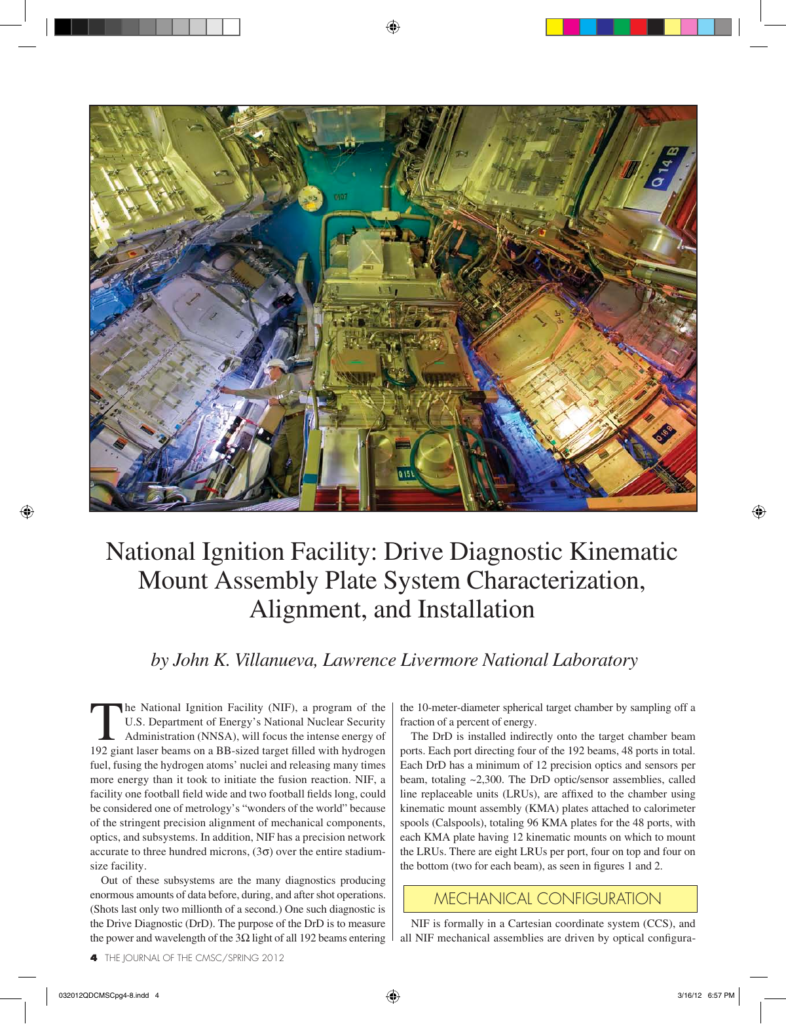
The National Ignition Facility (NIF), a program of the U.S. Department of Energy’s National Nuclear Security Administration (NNSA), will focus the intense energy of 192 giant laser beams on a BB-sized target filled with hydrogen fuel, fusing the hydrogen atoms’ nuclei and releasing many times more energy than it took to initiate the fusion reaction. NIF, a facility one football field wide and two football fields long, could be considered one of metrology’s “wonders of the world” because of the stringent precision alignment of mechanical components, optics, and subsystems. In addition, NIF has a precision network accurate to three hundred microns, (3σ) over the entire stadiumsize facility. Out of these subsystems are the many diagnostics producing enormous amounts of data before, during, and after shot operations. (Shots last only two millionth of a second.) One such diagnostic is the Drive Diagnostic (DrD). The purpose of the DrD is to measure the power and wavelength of the 3Ω light of all 192 beams entering the 10-meter-diameter spherical target chamber by sampling off a fraction of a percent of energy. The DrD is installed indirectly onto the target chamber beam ports. Each port directing four of the 192 beams, 48 ports in total. Each DrD has a minimum of 12 precision optics and sensors per beam, totaling ~2,300. The DrD optic/sensor assemblies, called line replaceable units (LRUs), are affixed to the chamber using kinematic mount assembly (KMA) plates attached to calorimet
Also published as CMS-2011-017, CMSC 2011, Phoenix, AZ.
Cite this article
John K. Villanueva. Lawrence Livermore National Laboratory. The Journal of the CMSC, Volume 7, Number 1, Spring 2012. Coordinate Metrology Society, reference CMSJ-07-1-01.