


Abstract
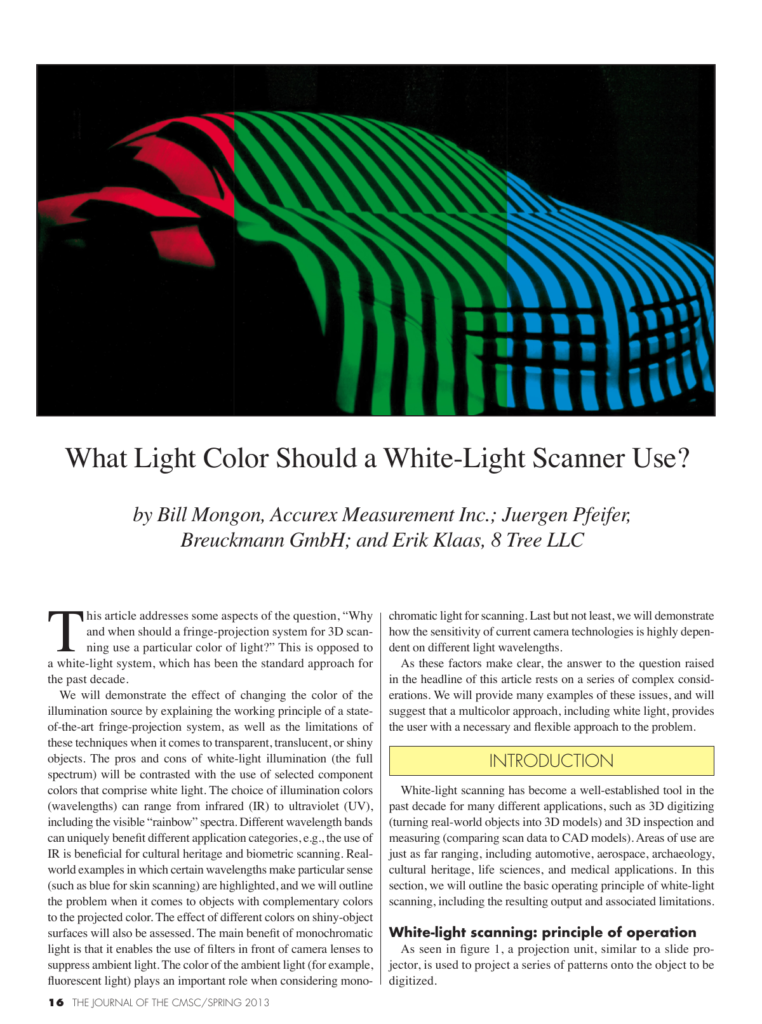
This article addresses some aspects of the question, “Why and when should a fringe-projection system for 3D scanning use a particular color of light?” This is opposed to a white-light system, which has been the standard approach for the past decade. We will demonstrate the effect of changing the color of the illumination source by explaining the working principle of a stateof-the-art fringe-projection system, as well as the limitations of these techniques when it comes to transparent, translucent, or shiny objects. The pros and cons of white-light illumination (the full spectrum) will be contrasted with the use of selected component colors that comprise white light. The choice of illumination colors (wavelengths) can range from infrared (IR) to ultraviolet (UV), including the visible “rainbow” spectra. Different wavelength bands can uniquely benefit different application categories, e.g., the use of IR is beneficial for cultural heritage and biometric scanning. Realworld examples in which certain wavelengths make particular sense (such as blue for skin scanning) are highlighted, and we will outline the problem when it comes to objects with complementary colors to the projected color. The effect of different colors on shiny-object surfaces will also be assessed. The main benefit of monochromatic light is that it enables the use of filters in front of camera lenses to suppress ambient light. The color of the ambient light (for example, fluorescent light) plays an important role
Cite this article
Bill Mongon, Juergen Pfeifer, Erik Klaas. Accurex Measurement Inc., Breuckmann GmbH, 8 Tree LLC. The Journal of the CMSC, Volume 8, Number 1, Spring 2013. Coordinate Metrology Society, reference CMSJ-08-1-03.