


Abstract
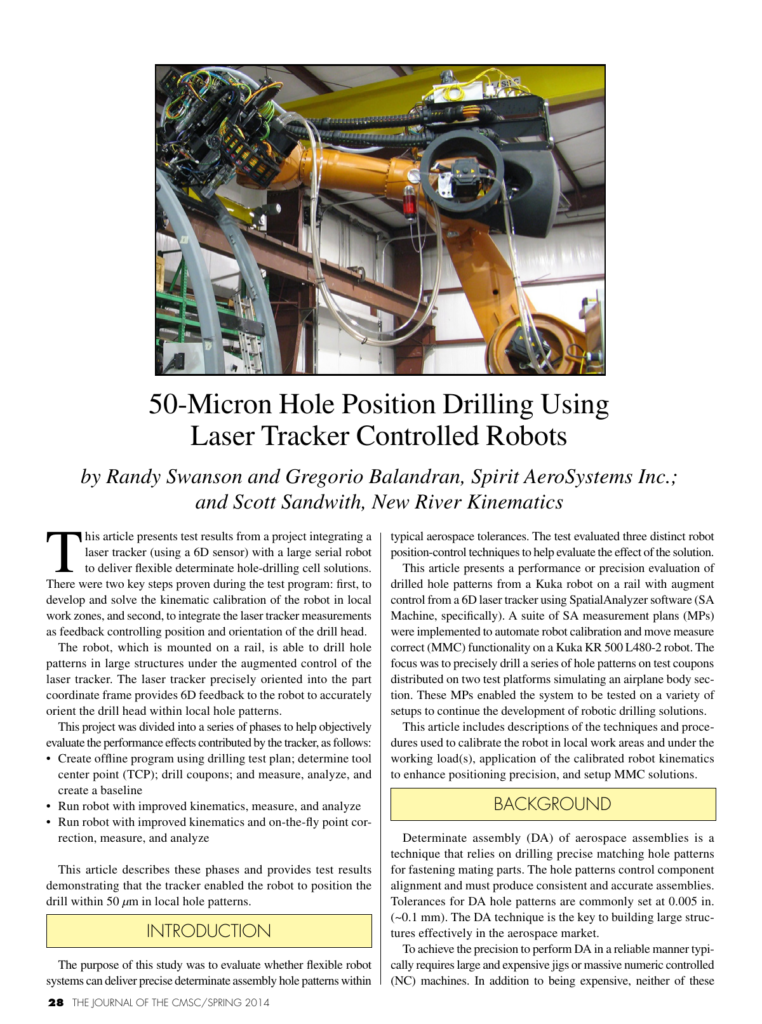
This article presents test results from a project integrating a laser tracker (using a 6D sensor) with a large serial robot to deliver flexible determinate hole-drilling cell solutions. There were two key steps proven during the test program: first, to develop and solve the kinematic calibration of the robot in local work zones, and second, to integrate the laser tracker measurements as feedback controlling position and orientation of the drill head. The robot, which is mounted on a rail, is able to drill hole patterns in large structures under the augmented control of the laser tracker. The laser tracker precisely oriented into the part coordinate frame provides 6D feedback to the robot to accurately orient the drill head within local hole patterns. This project was divided into a series of phases to help objectively evaluate the performance effects contributed by the tracker, as follows: • Create offline program using drilling test plan; determine tool center point (TCP); drill coupons; and measure, analyze, and create a baseline • Run robot with improved kinematics, measure, and analyze • Run robot with improved kinematics and on-the-fly point correction, measure, and analyze This article describes these phases and provides test results demonstrating that the tracker enabled the robot to position the drill within 50 μm in local hole patterns. typical aerospace tolerances. The test evaluated three distinct robot position-control techniques to help evaluate the effect of the
Cite this article
Randy Swanson, Gregorio Balandran, Scott Sandwith. Spirit AeroSystems Inc., New River Kinematics. The Journal of the CMSC, Volume 9, Number 1, Spring 2014. Coordinate Metrology Society, reference CMSJ-09-1-04.