


Abstract
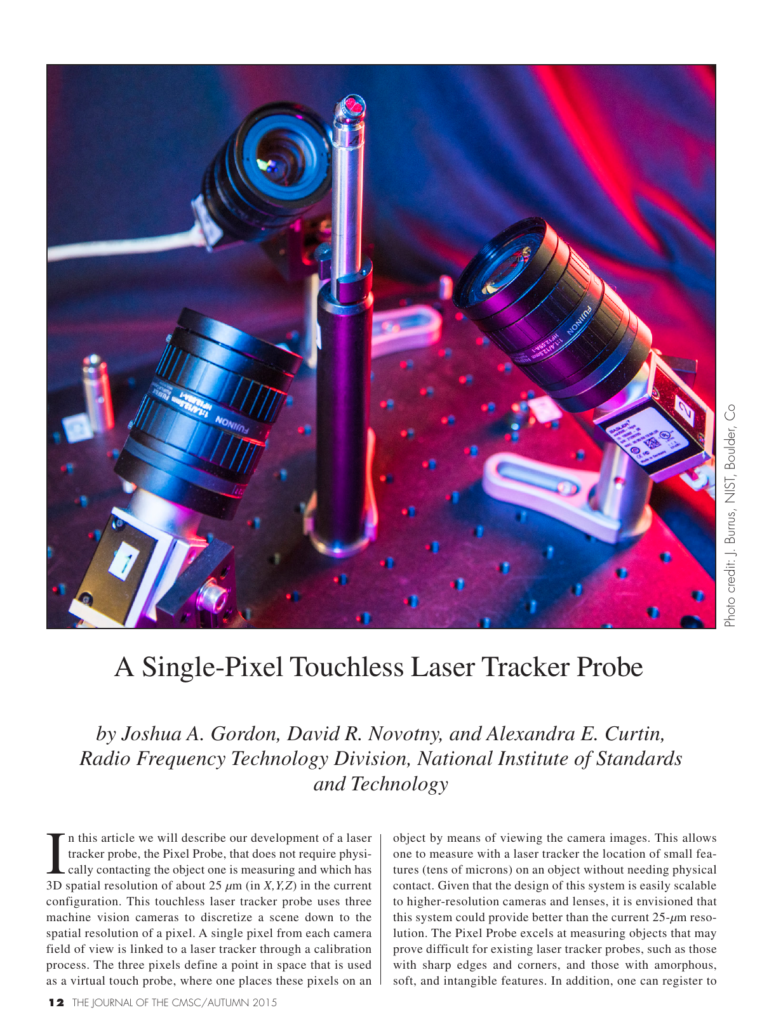
In this article we will describe our development of a laser tracker probe, the Pixel Probe, that does not require physically contacting the object one is measuring and which has 3D spatial resolution of about 25 μm (in X,Y,Z) in the current configuration. This touchless laser tracker probe uses three machine vision cameras to discretize a scene down to the spatial resolution of a pixel. A single pixel from each camera field of view is linked to a laser tracker through a calibration process. The three pixels define a point in space that is used as a virtual touch probe, where one places these pixels on an 12 THE JOURNAL OF THE CMSC/AUTUMN 2015 object by means of viewing the camera images. This allows one to measure with a laser tracker the location of small features (tens of microns) on an object without needing physical contact. Given that the design of this system is easily scalable to higher-resolution cameras and lenses, it is envisioned that this system could provide better than the current 25-μm resolution. The Pixel Probe excels at measuring objects that may prove difficult for existing laser tracker probes, such as those with sharp edges and corners, and those with amorphous, soft, and intangible features. In addition, one can register to
Also published as CMS-2015-012, CMSC 2015, Hollywood, FL.
Cite this article
Joshua A. Gordon, David R. Novotny, Alexandra E. Curtin. Radio Frequency Technology Division, National Institute of Standards and Technology. The Journal of the CMSC, Volume 10, Number 2, Autumn 2015. Coordinate Metrology Society, reference CMSJ-10-2-02.