


Abstract
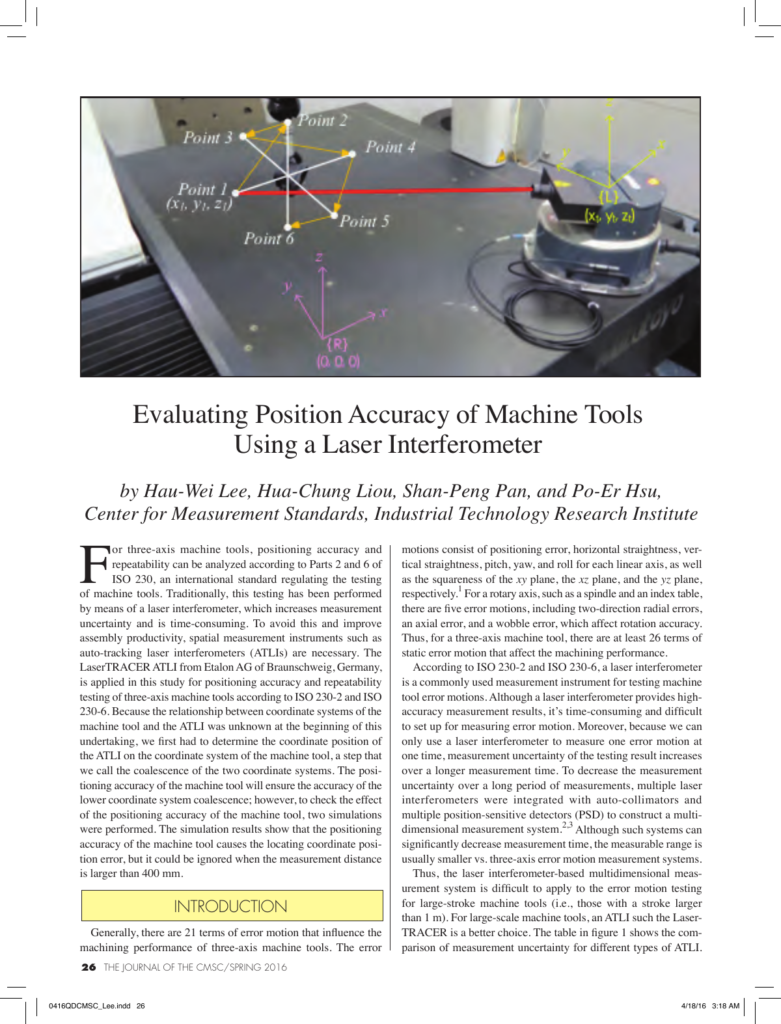
For three-axis machine tools, positioning accuracy and repeatability can be analyzed according to Parts 2 and 6 of ISO 230, an international standard regulating the testing of machine tools. Traditionally, this testing has been performed by means of a laser interferometer, which increases measurement uncertainty and is time-consuming. To avoid this and improve assembly productivity, spatial measurement instruments such as auto-tracking laser interferometers (ATLIs) are necessary. The LaserTRACER ATLI from Etalon AG of Braunschweig, Germany, is applied in this study for positioning accuracy and repeatability testing of three-axis machine tools according to ISO 230-2 and ISO 230-6. Because the relationship between coordinate systems of the machine tool and the ATLI was unknown at the beginning of this undertaking, we first had to determine the coordinate position of the ATLI on the coordinate system of the machine tool, a step that we call the coalescence of the two coordinate systems. The positioning accuracy of the machine tool will ensure the accuracy of the lower coordinate system coalescence; however, to check the effect of the positioning accuracy of the machine tool, two simulations were performed. The simulation results show that the positioning accuracy of the machine tool causes the locating coordinate position error, but it could be ignored when the measurement distance is larger than 400 mm. motions consist of positioning error, horizontal straightness, vertical stra
Also published as CMS-2015-011, CMSC 2015, Hollywood, FL.
Cite this article
Hau-Wei Lee, Hua-Chung Liou, Shan-Peng Pan, Po-Er Hsu. Center for Measurement Standards, Industrial Technology Research Institute. The Journal of the CMSC, Volume 11, Number 1, Spring 2016. Coordinate Metrology Society, reference CMSJ-11-1-04.