


Abstract
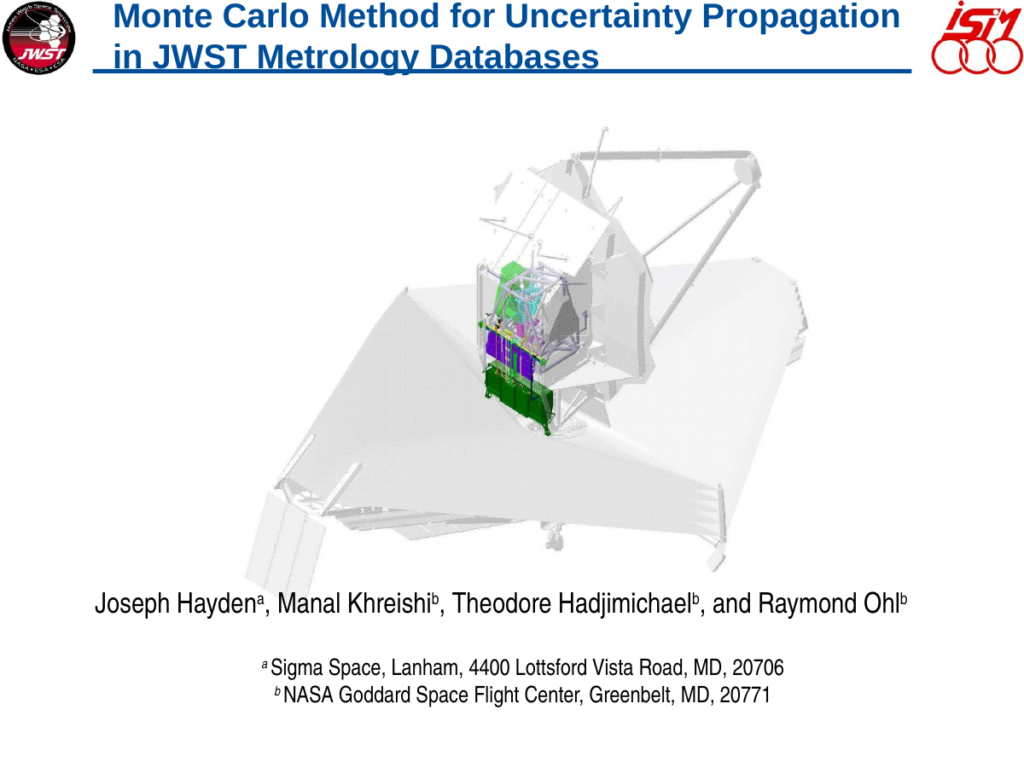
Large volume metrology measurements are conducted at every major phase of construction of the James Webb Space Telescope (JWST) at NASA Goddard Space Flight Center. Ambient and cryogenic metrology measurements are used to verify that the telescope components conform to their predicted position and orientation at various integration and alignment states. The fusing of multiple measurements and their uncertainties from a network of different metrology instruments is done using Spatial Analyzer software. The resulting measurements and their uncertainties constitute a database for a particular test configuration. A custom Monte Carlo (MC) uncertainty propagation routine, written in MATLAB, is used to propagate uncertainty through multiple metrology databases to estimate the uncertainty of the targets in the transformed database. The MC error propagation routine generates N-different geometric best-fit transformations between two separate databases with at least 3 corresponding targets. Each of the geometric transformations involves simulating target measurements from the sum of the nominal targets and their randomly-drawn uncertainties. The randomly-drawn uncertainties are defined by the probability density functions (PDF) for each of the targets in the databases. The dispersion in the N-simulated transformations is statistically evaluated to establish the PDF for each of the nominally transformed targets.
Cite this paper
Joseph Hayden, Manal Khreishi, Theodore Hadjimichael, Raymond Ohl. Sigma Space, Lanham, MD; NASA Goddard Space Flight Center, Greenbelt, MD. Presented at the Coordinate Metrology Systems Conference 2014, North Charleston, South Carolina, July 21-25, 2014. Coordinate Metrology Society, reference CMS-2014-029.