


Abstract
Modern manufacturing trends increase flexibility, increase frequency, and reduce the time to commissioning. Highly flexible virtual planning forms the basis for real production processes that must deal with machine, part, and process deviations. From FFT's point of view as a system integrator, there will be economic benefits if measurement technology is used not only for end-of-line control but also for other tasks in plant engineering via dual use or only temporarily during ramp-up. With the Nikon Metrology MV331-HS and the FFT-VisionVIEW software solution developed in-house, FFT equips body-in-white and battery cell lines with traceable automated measurement functions to ensure quality close to and integrated in the production flow. The latest version of the sensor technology used, the Nikon APDIS and the API Dynamic 9D LADAR, are highly flexible sensors for fully automatic optical probing that can be used in stationary and mobile applications or on robots.
Not all tasks in automated production require traceable measurements. High investment costs, many features with short cycle times and the lack of certified downtime predictions often require additional sensors. Robot-mounted light section sensors, such as a Keyence LJ-V7080B held by a Fanuc M-900iA, offer the ability to measure many points and can be evaluated by the existing processing pipeline; they can also be extended locally with the option to add traceable measured features. Another advantage of light section sensors is the availability of traceable systems such as the Hexagon AS1 with the AT960, creating a complete sensor palette for FFT-VisionVIEW.
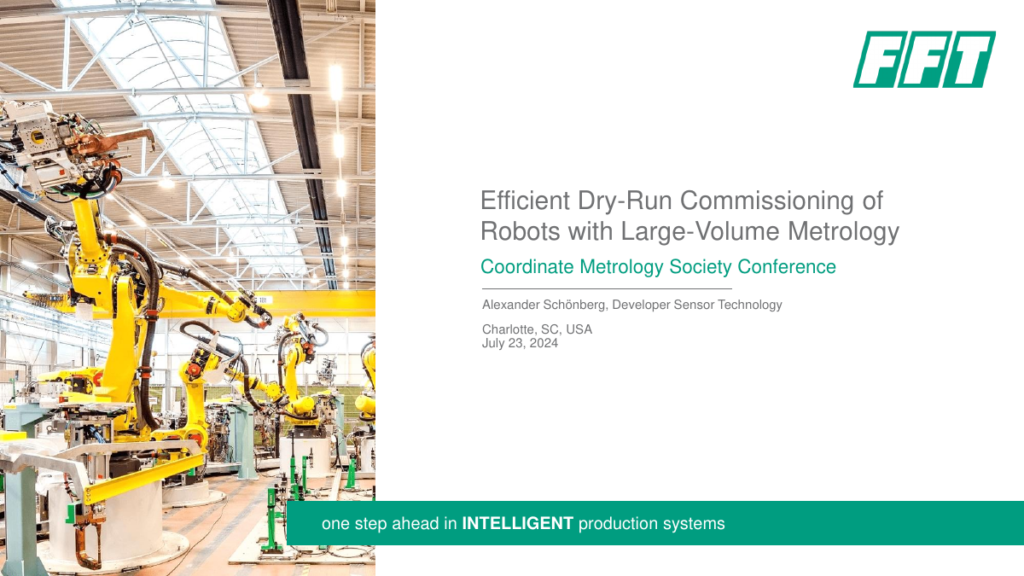
The integration of the sensors into a functional robot cell to manufacture large train parts with 4 Fanuc M-1000iA robots holding welding guns with 400 kg tools demonstrates the dual usability of the optical sensors. Two of the robots on opposing sides are equipped with Keyence LJ-X8900 sensors, which have the task of flexibly determining the condition of the clamps and the presence of parts to ensure a clean system condition during automatic production. In addition, FFT-VisionVIEW uses the sensors to measure part deviations and provides the information to the online guidance and collision avoidance system to enable advanced welding strategies with optimal geometric results. During commissioning, ramp-up and maintenance, an API Dynamic 9D LADAR is temporarily inserted into the station on a moving stand to support the set-up and check system behavior during the initial commissioning without parts being available yet. Principles of the dry-run phase of setting-in will be shown, and technical details will also be explained in a demonstration set-up to explain the system functionality in more detail.
Cite this paper
Alexander Schonberg. FFT Produktionssysteme GmbH & Co. KG, Fulda, Germany. Presented at the Coordinate Metrology Systems Conference 2024, Charlotte, North Carolina, July 22-25, 2024. Coordinate Metrology Society, reference CMS-2024-002.