


Abstract
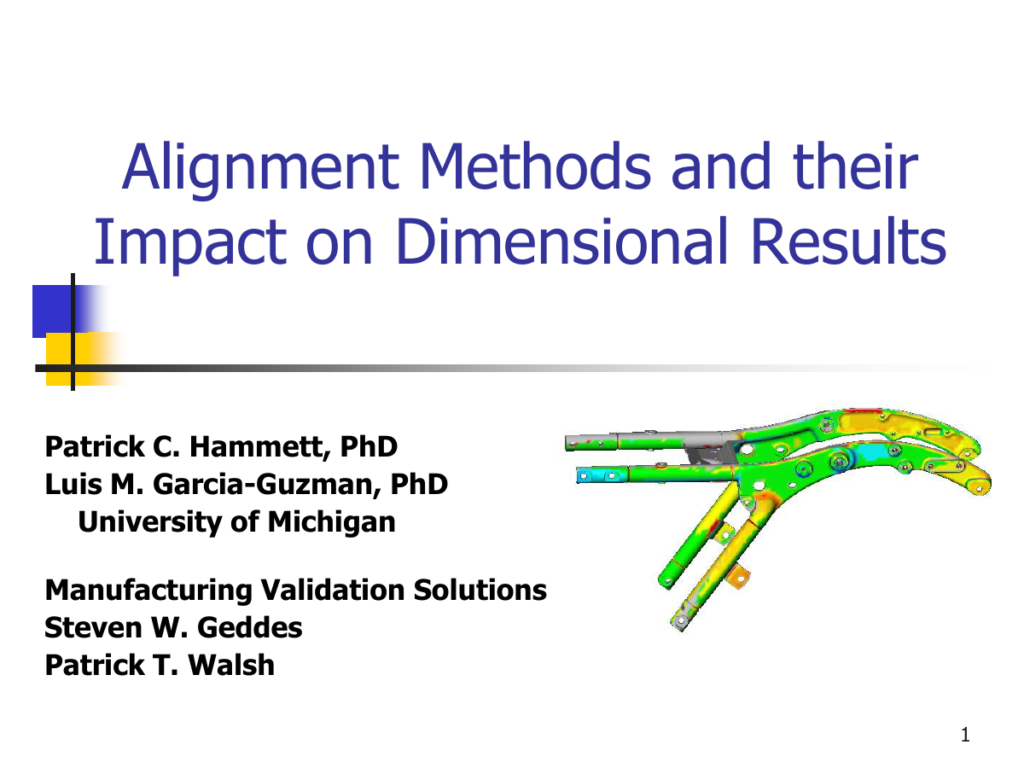
Suppose you have a complex non-rigid part with full GD&T – datums, key features, tolerances. The customer asks a straightforward question; the measurement operator gives a straightforward answer; and the customer says you did not really answer the question. That exchange is where this talk starts. Patrick Hammett reviews the conventional sources of measurement error, sets out the general methods for alignment – best fit being a non-specific term covering several – and shows the practical effect of over-constraints in post-processing. The case study is a frame section: 33 dimensions, several alignment methods compared, static repeatability across fixture load and unload, dynamic repeatability between two alignment methods, and the systematic mean effect that alignment choice introduces. The conclusion is aimed at new product development, where the attention is cheapest to pay.
Also published as CMSJ-05-1-02, The Journal of the CMSC, Volume 5, Number 1 (Spring 2010).
Cite this paper
Patrick C. Hammett, Luis M. Garcia-Guzman, Steven W. Geddes, Patrick T. Walsh. University of Michigan, Manufacturing Validation Solutions. Presented at the Coordinate Metrology Systems Conference 2009, Louisville, Kentucky, July 20-24, 2009. Coordinate Metrology Society, reference CMS-2009-005.