


Abstract
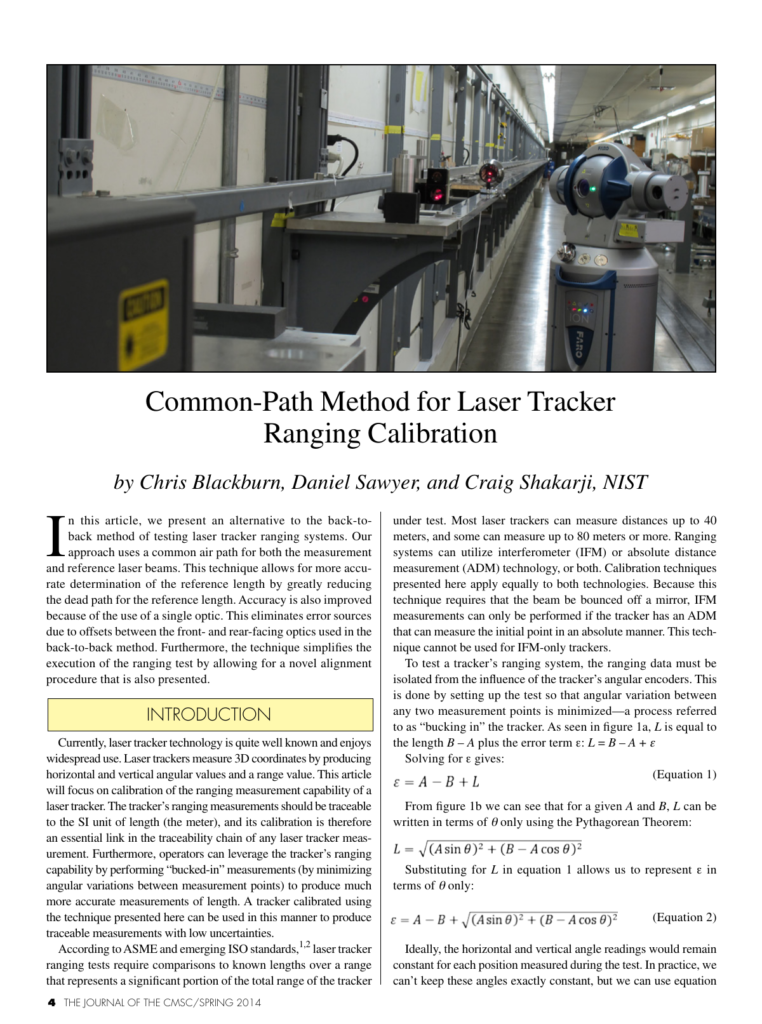
In this article, we present an alternative to the back-toback method of testing laser tracker ranging systems. Our approach uses a common air path for both the measurement and reference laser beams. This technique allows for more accurate determination of the reference length by greatly reducing the dead path for the reference length. Accuracy is also improved because of the use of a single optic. This eliminates error sources due to offsets between the front- and rear-facing optics used in the back-to-back method. Furthermore, the technique simplifies the execution of the ranging test by allowing for a novel alignment procedure that is also presented. under test. Most laser trackers can measure distances up to 40 meters, and some can measure up to 80 meters or more. Ranging systems can utilize interferometer (IFM) or absolute distance measurement (ADM) technology, or both. Calibration techniques presented here apply equally to both technologies. Because this technique requires that the beam be bounced off a mirror, IFM measurements can only be performed if the tracker has an ADM that can measure the initial point in an absolute manner. This technique cannot be used for IFM-only trackers. To test a tracker’s ranging system, the ranging data must be isolated from the influence of the tracker’s angular encoders. This is done by setting up the test so that angular variation between any two measurement points is minimized—a process referred to as “bucking in” the tracker. As seen
Cite this article
Chris Blackburn, Daniel Sawyer, Craig Shakarji. National Institute of Standards and Technology (NIST). The Journal of the CMSC, Volume 9, Number 1, Spring 2014. Coordinate Metrology Society, reference CMSJ-09-1-01.