


Abstract
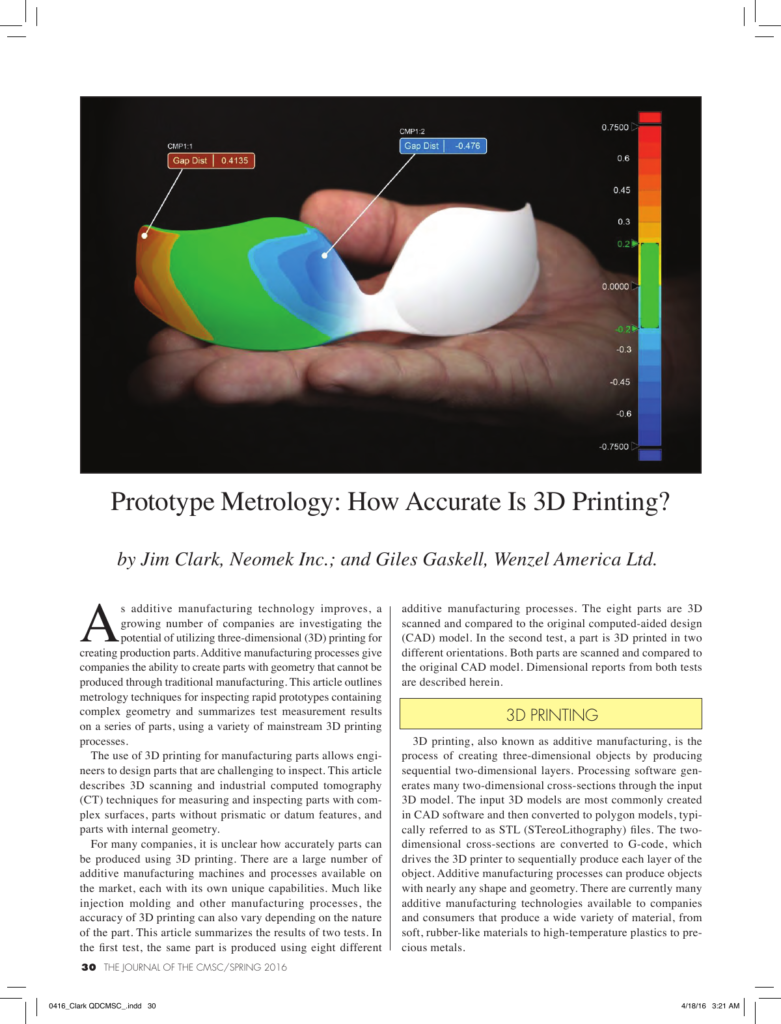
As additive manufacturing technology improves, a growing number of companies are investigating the potential of utilizing three-dimensional (3D) printing for creating production parts. Additive manufacturing processes give companies the ability to create parts with geometry that cannot be produced through traditional manufacturing. This article outlines metrology techniques for inspecting rapid prototypes containing complex geometry and summarizes test measurement results on a series of parts, using a variety of mainstream 3D printing processes. The use of 3D printing for manufacturing parts allows engineers to design parts that are challenging to inspect. This article describes 3D scanning and industrial computed tomography (CT) techniques for measuring and inspecting parts with complex surfaces, parts without prismatic or datum features, and parts with internal geometry. For many companies, it is unclear how accurately parts can be produced using 3D printing. There are a large number of additive manufacturing machines and processes available on the market, each with its own unique capabilities. Much like injection molding and other manufacturing processes, the accuracy of 3D printing can also vary depending on the nature of the part. This article summarizes the results of two tests. In the first test, the same part is produced using eight different additive manufacturing processes. The eight parts are 3D scanned and compared to the original computed-aided design (CAD) model.
Also published as CMS-2015-017, CMSC 2015, Hollywood, FL.
Cite this article
Jim Clark, Giles Gaskell. Neomek Inc., Wenzel America Ltd. The Journal of the CMSC, Volume 11, Number 1, Spring 2016. Coordinate Metrology Society, reference CMSJ-11-1-05.