


Abstract
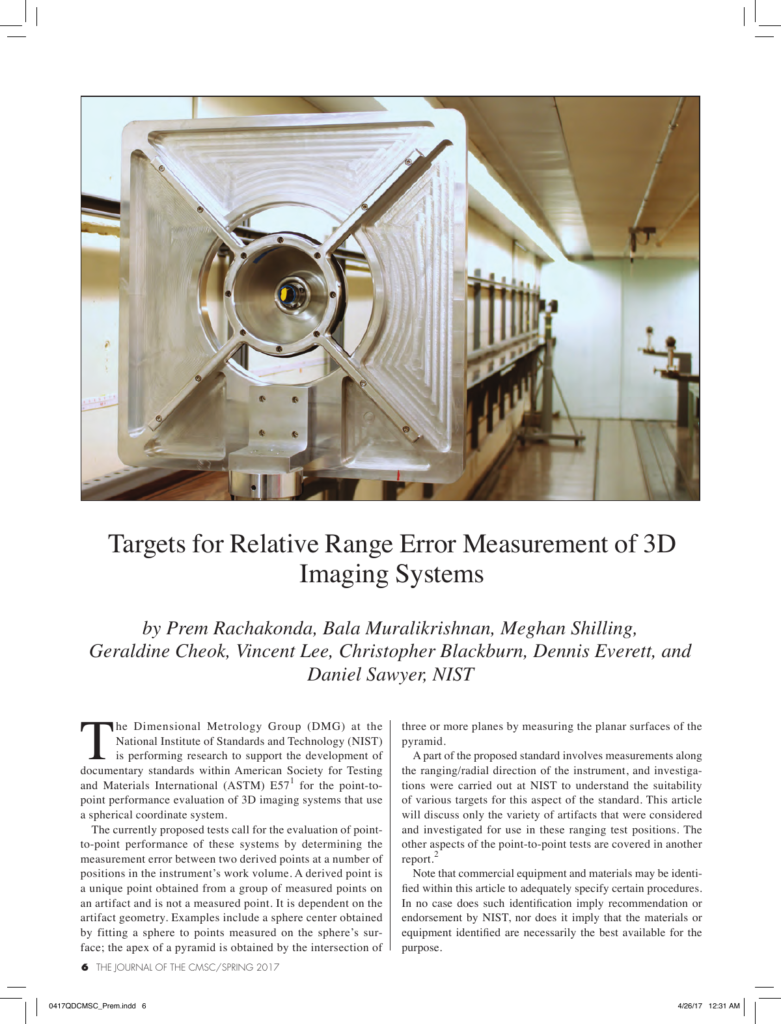
The Dimensional Metrology Group (DMG) at the National Institute of Standards and Technology (NIST) is performing research to support the development of documentary standards within American Society for Testing and Materials International (ASTM) E57 1 for the point-topoint performance evaluation of 3D imaging systems that use a spherical coordinate system. The currently proposed tests call for the evaluation of pointto-point performance of these systems by determining the measurement error between two derived points at a number of positions in the instrument’s work volume. A derived point is a unique point obtained from a group of measured points on an artifact and is not a measured point. It is dependent on the artifact geometry. Examples include a sphere center obtained by fitting a sphere to points measured on the sphere’s surface; the apex of a pyramid is obtained by the intersection of three or more planes by measuring the planar surfaces of the pyramid. A part of the proposed standard involves measurements along the ranging/radial direction of the instrument, and investigations were carried out at NIST to understand the suitability of various targets for this aspect of the standard. This article will discuss only the variety of artifacts that were considered and investigated for use in these ranging test positions. The other aspects of the point-to-point tests are covered in another report.2 Note that commercial equipment and materials may be identified within this articl
Also published as CMS-2016-020, CMSC 2016, Nashville, TN.
Cite this article
Prem Rachakonda, Bala Muralikrishnan, Meghan Shilling, Geraldine Cheok, Vincent Lee, Christopher Blackburn, Dennis Everett, Daniel Sawyer. National Institute of Standards and Technology (NIST). The Journal of the CMSC, Volume 12, Number 1, Spring 2017. Coordinate Metrology Society, reference CMSJ-12-1-01.